
The aluminium extrusion process shapes aluminium by forcing a heated billet through a specially designed die. This method allows manufacturers to create long pieces with precise and consistent shapes. Learn more about aluminium extrusion and its applications across industries.
In this article, we will break down the 5 main steps of the extrusion process, showing how each stage works and why it is important.
Think of it like squeezing toothpaste through a shaped opening: the paste takes the shape of the nozzle, just as material takes the shape of the die during extrusion.
Step 1: Preparing the Material for the Aluminium Extrusion Process
The first step in the extrusion process is selecting and preparing the raw material, usually a solid aluminium block called a billet. The quality of this billet is very important, as any impurities or inconsistencies can affect the final product.
Before extrusion, the billet may undergo a preliminary inspection and trimming to remove imperfections. This is often done using extrusion machining, which ensures the material is the right size and ready for shaping.
Proper preparation helps the extrusion process run smoothly, improving precision and reducing the risk of defects in the final profiles.
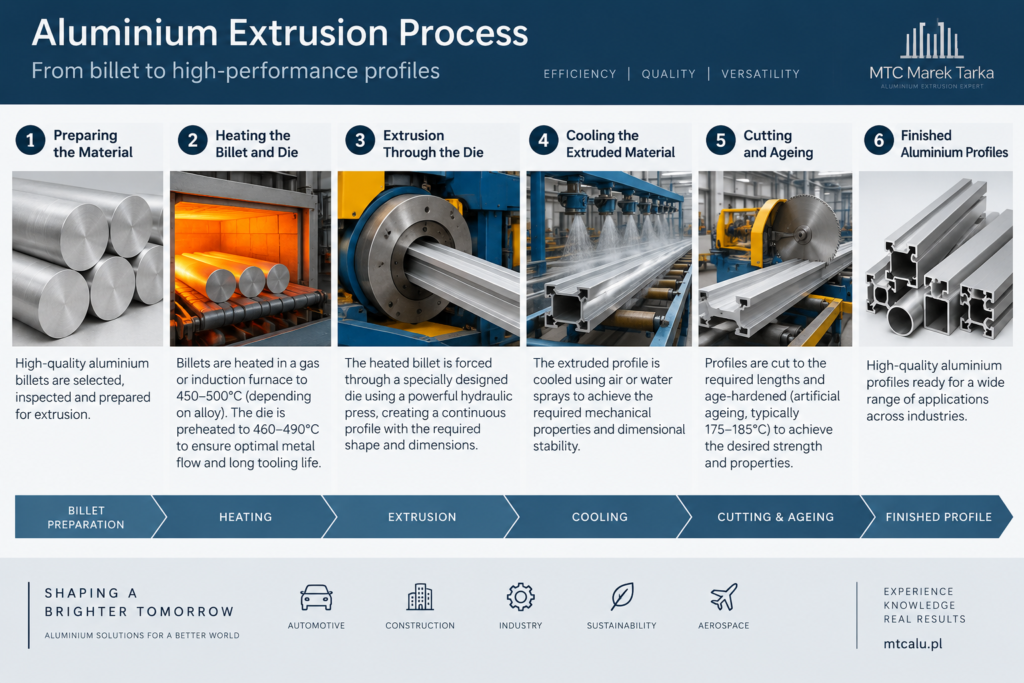
Step 2: Heating the Billet and Die
The aluminium extrusion process begins by heating aluminium billets in a gas or induction billet furnace to the required extrusion temperature, typically 440–500°C, depending on the alloy.
Purpose:
- Ensure optimum metal flow during extrusion.
- Achieve uniform billet temperature throughout its length.
- Reduce extrusion force and improve surface quality.
- Maximize productivity while preventing overheating.
The extrusion die is preheated before installation in the press to approximately 460 – 480°C. Proper die temperature minimizes thermal shock and extends tooling life.
Purpose:
- Protect the die from thermal cracking.
- Improve metal flow.
- Produce consistent profile dimensions and surface finish.
- Increase die life and reduce correction time.
Step 3: Extrusion Through the Die
Extrusion (Billet 450–500°C | Profile Exit 500–580°C)
During the aluminium extrusion process, the heated billet is loaded into the press container and forced through the die by a hydraulic ram. The aluminium exits the die in the required cross-sectional shape.
Purpose:
- Form the required profile geometry.
- Control ram speed, pressure, and metal flow.
- Achieve maximum productivity while maintaining excellent surface quality.
- Minimize scrap and extrusion defects
Step 4: Cooling the Extruded Material
Run-Out & Controlled Cooling (Profile Exit 500–580°C → Cooling to 40–80°C)
Once the aluminium has passed through the die, it must be cooled to maintain its strength and shape. Cooling can be done using air, water, or specially controlled chambers, depending on the type of profile and production requirements.
Proper cooling is important to prevent warping, shrinkage, or surface imperfections. By controlling the cooling process, manufacturers ensure that the extruded material remains strong, precise, and ready for the next stage of processing.
Purpose:
- Maintain profile straightness.
- Control the cooling rate to achieve the desired mechanical properties.
- Prevent twisting, distortion, and surface defects.
- Prepare the profile for stretching.
Stretching (Typically below 40–60°C)
Once sufficiently cooled, the profile is stretched by approximately 0.5–2.0% of its length to remove residual stresses and correct any distortion.
Purpose:
- Eliminate twists and bends.
- Improve straightness and dimensional accuracy.
- Release internal stresses created during extrusion.
- Prepare profiles for final cutting.
Step 5: Cutting and Ageing
After stretching, profiles are cut to the required customer lengths using precision saws.
Purpose:
- Produce accurate finished lengths.
- Remove profile ends affected during stretching.
- Minimize scrap and prepare material for ageing or fabrication.
Ageing (Artificial Heat Treatment) (175–185°C)
Profiles are placed in an ageing oven at 175–185°C for a controlled period, depending on the alloy and required temper (T5, T6, T66).
Purpose:
- Increase mechanical strength and hardness through precipitation hardening.
- Achieve the specified temper.
- Ensure stable and repeatable mechanical properties.
- Meet customer and international standards (e.g., EN, ISO 90001,IATF 16949)
Quality , Surface Finishing, Machining and Packing
Typical inspections include:
- Dimensional measurements
- Surface quality assessment
- Straightness verification
- Mechanical property testing
- Hardness and tensile testing
- Visual inspection for defects
Purpose:
- Ensure compliance with customer specifications.
- Detect and eliminate defects before shipment.
- Maintain consistent product quality.
Surface Finishing (Optional)
Depending on customer requirements, profiles may undergo additional finishing processes.
Typical processes:
- Anodizing
- Powder coating
- Polishing
- Brushing
Purpose:
- Improve corrosion resistance.
- Enhance appearance.
- Increase durability and wear resistance.
Fabrication & CNC Machining (Optional)
Many extrusion plants provide value-added operations after extrusion.
Typical operations:
- CNC machining
- Drilling
- Milling
- Tapping
- Precision cutting
- Assembly
Purpose:
- Deliver finished components ready for installation.
- Reduce customer processing time and cost.
Packaging & Shipping
Finished profiles are carefully packed, labelled, and protected for transportation.
Purpose:
- Prevent scratches and mechanical damage.
- Maintain traceability.
- Ensure products reach the customer in perfect condition.
Every stage of the extrusion process is interconnected. Consistent temperature control, standardized operating procedures, skilled personnel, and continuous process monitoring are the keys to achieving high productivity, outstanding quality, low scrap rates, and safe, reliable operations. Even the most advanced extrusion press cannot deliver world-class performance without disciplined control of every step in the process.
Contact
Looking to improve your aluminium extrusion process?
Whether you need support with die design, process optimisation, productivity improvement, quality enhancement, or operator training, I’m here to help.
With over 29 years of hands-on extrusion experience, I provide practical solutions tailored to your plant, your products, and your challenges.
Let’s discuss how we can improve your extrusion performance.
Contact me today.
